
Linda R.
58 · Tennessee
★★★★★
“What convinced me was learning that resistance activity can mean things I already do — carrying bags, stairs, garden work. It did not ask me to become someone I am not.”
 STILL CAPABLE | HEALTH
Healthy aging, explained clearly
What changes after 50? What can creatine support? Why is magnesium there? Here are 10 clear answers, without the hype.
Start the Routine — From $99
You know your body. You always have. You notice when a normal task starts taking a little more thought. That does not mean something is wrong. It does mean the change is worth noticing.
One hard day cannot tell you the cause. Sleep, stress, illness, food and recent activity can all change how you feel. The useful question is simpler: what can support strength and normal muscle function while you keep living your life?


A long walk. An afternoon in the yard. A busy day away. You did it. Then the next morning got more of your attention than it used to.
Many things can change how a day feels. What the pattern does show is why everyday capability matters. You do not care about strength as a number. You care because life keeps going after the first task.

Maybe you pause before getting down low. Maybe you think twice about the heavy bag or the longer route. You can still do it. You simply think about it first.
That small pause gets at the real concern: more negotiation with the body than there used to be.
And if you already have a drawer full of half-used supplements, “try another bottle” can feel exhausting. The goal is not more products. It is a clearer reason for each one.

Groceries. Stairs. A suitcase. A hill. Getting down on the floor. These are not fitness goals. They are normal life.
Your body already makes creatine. Most of it is stored in skeletal muscle. It helps muscle cells make quick energy when the work gets hard.
Creatine got a gym image. The biology is not gym-only.
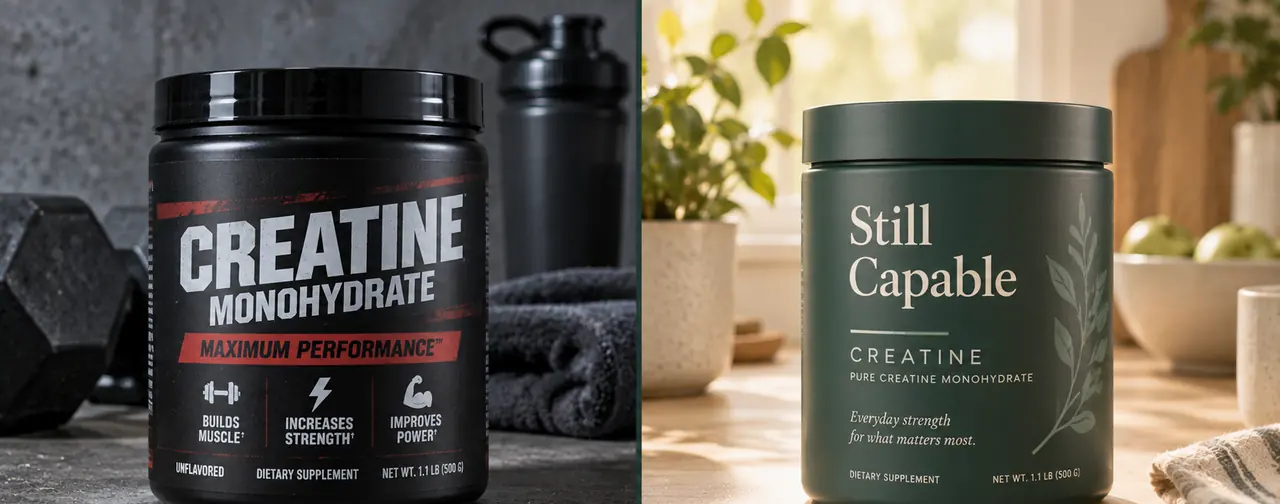
Some days feel easier than others. Sleep, food, stress, illness and recent activity can all change a day.

Creatine is not an instant feeling. Without a loading phase, muscle creatine builds over time. Classic research found that 3 g a day raised muscle creatine over about 28 days.
Still Capable uses 5 g daily. Muscle stores may fill sooner than in that 3 g/day study, but timing varies. Treat 28 days as a research reference, not a promise for this product.
So do not chase day-to-day feelings. Stay consistent. Then look at a few simple, repeatable benchmarks over several weeks.


The real question is not, “Am I strong?” It is, “How many ordinary choices do I still want in the conversation?”
The walk or the errands. The yard or dinner out. The trip or the easier option. Not because you cannot do both. Because you have started thinking about how to arrange them.
That is the heart of Still Capable. The goal is not youth. It is participation.
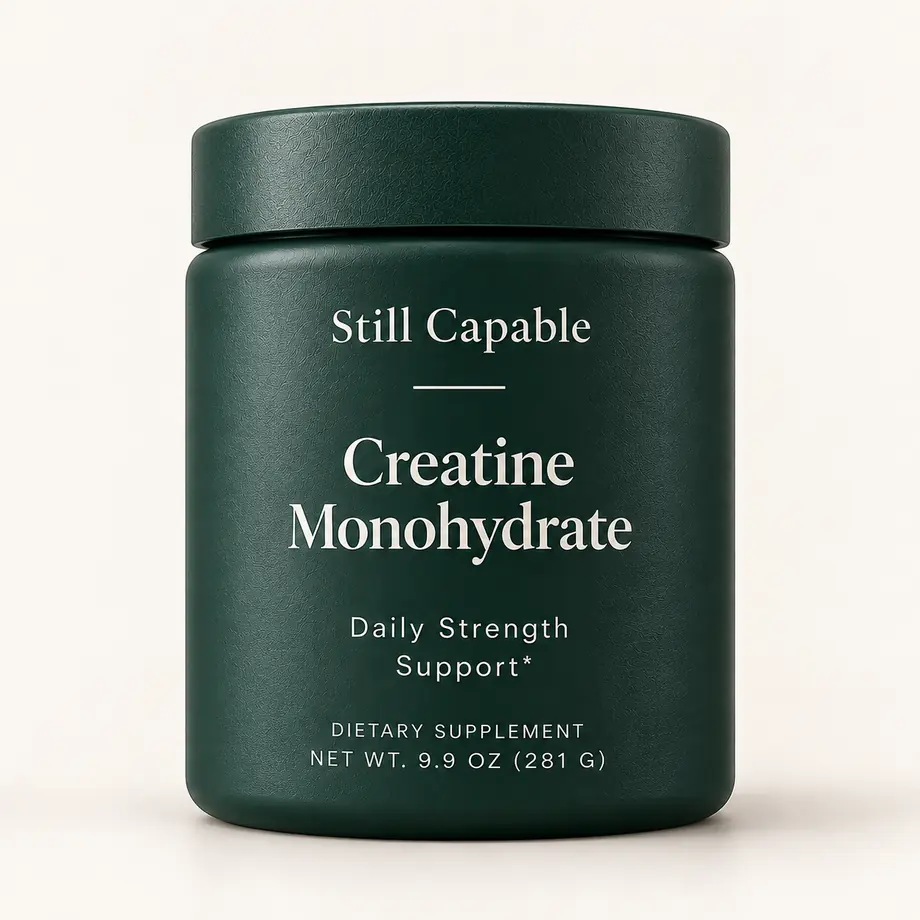
Job: muscle energy and strength.
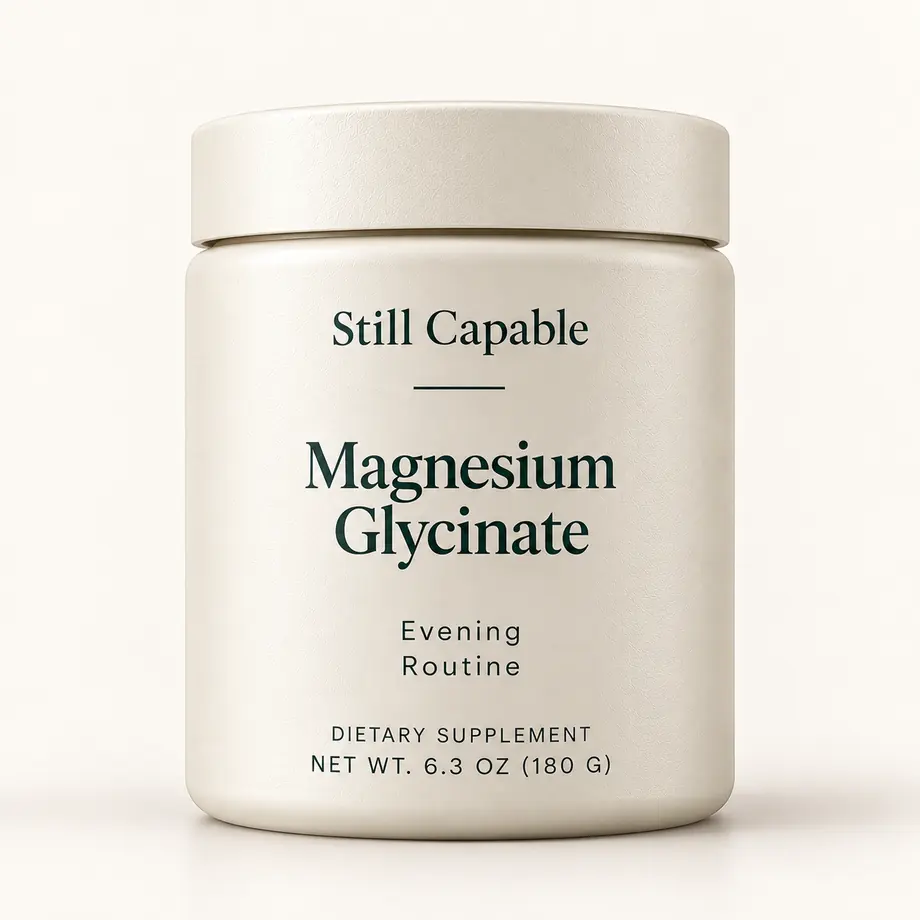
Best evidence: use creatine with resistance exercise or other strength work.Job: normal muscle and nerve function.
Evening is a memory cue. It is not a sleep claim.No secret synergy. Each ingredient has its own job.
*Follow the final product label if serving information changes.The point is not to become a different person. It is to make the routine clear enough to fit the life you already have.
“What convinced me was learning that resistance activity can mean things I already do — carrying bags, stairs, garden work. It did not ask me to become someone I am not.”

“I have a drawer full of supplements I keep meaning to take and forget about. Two clear things with two clear jobs made this much easier to keep.”

“I had spent money on supplements before. The 365-day guarantee made trying this feel less rushed.”
Magnesium is an essential mineral. It supports normal muscle and nerve function. That is why it has a place in this routine.
Magnesium comes in different forms. Check the form. Check the elemental amount.
Still Capable uses magnesium glycinate. We do not use a fake “80% absorbed” number. Research does not support one simple number for every person.
Count the steps. Track the workout. Add another powder. Add another bottle. Healthy aging can start to feel like a hobby you never asked for.

The women Still Capable was built around do not want their body to become their hobby. They want their body to support their work, family, travel, garden and plans.

Life is the main event. The wellness routine should stay quietly in the background.
Ask two things: “What am I taking?” and “Why is it here?”
*Follow the serving size and directions on the final product label.
Each ingredient has one job.
Movement, food, sleep and medical care still matter.
Still Capable comes with a 365-day money-back guarantee. Use the routine in real life. Give the habit time to become normal. Then decide if it belongs in your day.
No rushed three-day verdict. No need to decide before you have even built the habit.
Creatine for muscle energy and strength. Magnesium for normal muscle and nerve function. One purchase. Two clear steps. One 365-day guarantee.
No. Your body already makes creatine. Your muscles use it. Gym culture gave it a gym image, but the biology is not gym-only.
Movement still matters. The clearest strength evidence in older adults is with resistance or other muscle-loading activity.
Creatine can raise a blood marker called creatinine. That marker is used in some kidney tests. A small rise does not always mean kidney damage. A 2025 review found a small rise in creatinine but no significant change in GFR. If you have kidney disease or unusual kidney tests, ask your clinician before use. Tell them you take creatine before bloodwork. See the review.
Some people see a small scale change as muscle creatine and body water rise. Individual response varies. One controlled study found more total body water but no change in fluid distribution. See the study.
Do not expect an overnight feeling. Without a loading phase, muscle creatine builds over time. Stay consistent for several weeks and compare simple, repeatable tasks instead of one good or bad day.
Magnesium has a separate role. It supports normal muscle and nerve function.
We do not claim a special combined effect. They are paired because they have two separate jobs in one simple routine.
Creatine by itself does not create a bodybuilding physique. Training, food, genetics and time all matter.
You can. Still Capable is for someone who wants the routine already simplified: one purchase, two clear roles and one guarantee.
Ask a doctor or pharmacist before use if you have a health condition, take prescription medicine, are pregnant or nursing, or have been told to limit supplements or minerals.
Research describes groups, not a guaranteed result for one person. Individual experiences vary.